Showing posts with label Nobel Laureate. Show all posts

Tuesday, April 19, 2022

Today (April 20, 1918) is the Memorial Day of Nobel Prize-winning German inventor Karl Ferdinand Braun, who pioneered the development of wireless communication in radio and television.

Today (April 20, 1918) is the memorial day of Nobel Prize-winning German inventor Karl Ferdinand Braun, who pioneered the development of wireless communication in radio and television.


Karl Ferdinand Braun was born on June 6, 1850, in Bulda, Hessen Castle, Germany. He attended a grammar school in the county. He was interested in education at a young age and was well versed in science. He wrote science articles at an early age and they were all published in various journals. Eager to become a science teacher, he enrolled at the University of Marburg, taking science and mathematics as subjects. He then moved to the University of Berlin where he studied physics as a speciality. He received his master's degree in 1872 and later his doctorate. In 1885 he married Amelie Buckler.


Served as an assistant to Professor Qing of the University of Ursburg. In 1874, he joined St. Thomas' School in Leipzig as a teacher. Two years later, he was hired as the best professor of theoretical physics at the University of Marburg. In 1880, he was invited to the same job at the University of Strasbourg. In 1883, he became a professor of physics at the College of Technology in Karlskuw. He eventually joined the University of Dubinson in 1885. There ,he created a new physical education institute. He then returned to the University of Strasbourg in 1895, two years later. There he became the head of the Institute of Physics.


His first study was on the oscillations of strings and elastic. He examined how the wires set their oscillations according to the operating conditions and the nature of the wire's range of motion. He studied the theory of thermodynamics and the study of how the solubility of solids changes with pressure.  His primary research work was on electronics. He published research papers on variations from Ohm's law and on calculating the force of electricity on elements that are reversible from heat sources.


He focused on the study of the electrical conductivity of dissolved metal salts in electrodes. In them, he studied the conductivity of insoluble metal sulfide crystals and other crystalline solids. He found that in many metal sulfides, the magnitude of the resistance varies according to the directions and magnitudes of the applied voltage.  He used the electrolytic properties of galena, a low-conductivity crystal mixed with carbon sulfide, to form two electrodes. This was the first faulty conductor of the day. It was not widely used at the time but became widely used in 1948.


Braun spent twenty years at the university teaching and studying physics. Developed a variety of electronic tools. In 1897, he developed a cathode ray oscilloscope and an electrometer. He did not receive a patent for I,t but wrote and published an explanatory essay so that anyone could understand how it should be operated. It was during this time that he developed the idea of ​​emitting negative rays, and X-rays were discovered.

In 1898, he focused on the study of the wireless telegraph system. Morse transmitted gestures through the water with the help of a high-frequency current. Introduced the closed circuit of the wave. He made electric gestures in specific directions. In 1902, he succeeded in retrieving the waves sent by the inclined transmitter device. He wrote and published these in detail under the title Wireless Telegraph in Water and Air. He shared the 1909 Nobel Prize with Marconi, the scholar who discovered radio by studying wireless communication. Spawned the development of radio and television technology.


After World War I, he went to the United States to testify in a legal patent case. He has not been involved in research since then. He spent his last years in the United States. Nobel Prize-winning German inventor Karl Ferdinand Braun passed away on April 20, 1918, in New York, USA, at 67.

Source: Wikipedia

Information: Dr. P. Ramesh, Assistant Professor of Physics, Nehru Memorial College, Puthanampatti, Trichy.


Friday, February 25, 2022

Today (February 26, 1931) is the Memorial Day of Otto Wallach, the German scientist who won the Nobel Prize in Chemistry for his study of molecular structure.

Today (February 26, 1931) is the Memorial Day of Otto Wallach, the German scientist who won the Nobel Prize in Chemistry for his study of molecular structure. 


Otto Wallach was born on March 27, 1847, in Gonisburg, Russia to a Jewish family. Father, civil servant. Attended gymnasium school in Poston. Literature and art history are usually taught in schools then. Wallach was very interested in both of these. Studied chemistry privately at home. He also carried out some chemical experiments at home out of self-interest. He later studied doline isomer at the University of Cottingham and received his doctorate at the age of 22. Participated in the Franco-Prussian War at the invitation of the government. After the war, he decided to stay in Berlin and began working in a factory there. Due to ill health, Bon moved to the city.

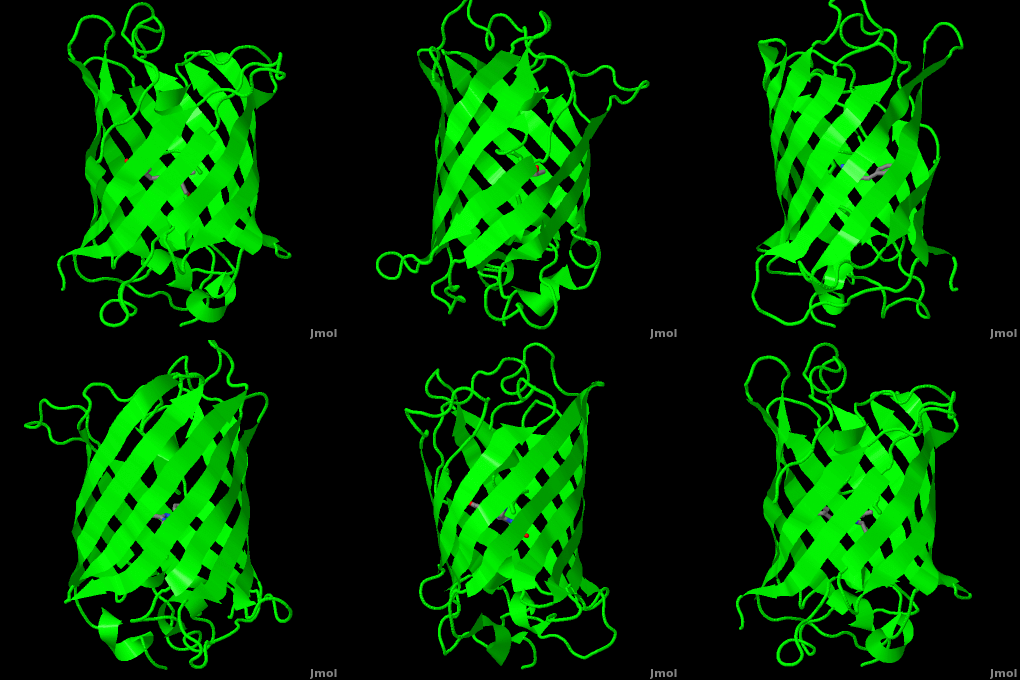
 Green Fluorescent Protein - Proteopedia, life in 3D

He first joined the University of Bonn as an assistant in the organic laboratory. He later worked as a lecturer and professor there. Worked here for about 19 years. He was first appointed Professor of Pharmacology. To improve himself in the field, he studied many books and did many types of research. Detected immunochlorides by the action of phosphorus pentachloride on acid amides. According to a scientist who was his mentor in college, he studied turbines in oils. Explored the molecular structure of these. He conducted this study using several methods, including melting comparison and measurement of compounds. Examined the reactions of turbines. He authored a 600-page book, Turbine and Camper, about his research. He subsequently undertook several studies. He also played an important role in chemical theoretical research.

 The Nobel Prize in Chemistry 1990 - NobelPrize.org

Gottingen was elected director of the Chemical Institute. Wallach rule, Wallach decay, Lucard-Wallach verb, Wallach restoration are all referred to by his name. He carried out various researches on turpentine and essential oils and made many discoveries. The chemical industry, which uses essential oils to make perfumes and food, has benefited. He was awarded the Nobel Prize in Chemistry in 1910 for his research on the alicyclic compound known as the fatty compound and for his contribution to organic chemistry. In 1912 he received the Davey Medal.


Elected Member of the German Chemical Society. He has been awarded an honorary doctorate by several universities, including Manchester and Leipzig. He carried out various researches till the end. Otto Wallach, one of Germany's notable chemists, passed away on February 26, 1931, at the age of 84 in Gothenburg, Germany.

Source By: Wikipedia.

Information: Dr. P. Ramesh, Assistant Professor of Physics, Nehru Memorial College, Puthanampatti.


Thursday, October 21, 2021

Today (October 22, 1881) is the Birthday of Nobel laureate Clinton Joseph Davison, who discovered that electrons have the same interference effect as light waves.

Today (October 22, 1881) is the Birthday of Nobel laureate Clinton Joseph Davison, who discovered that electrons have the same interference effect as light waves.

Clinton Joseph Davisson was born on October 22, 1881, in Bloomington, Illinois, USA. He graduated from Bloomington High School in 1902. He also received a scholarship to the University of Chicago. On the recommendation of Robert A. Milligan, in 1905 Davison was appointed Physics Instructor at Princeton University. He received his P.S. He graduated from Chicago in 1908. Mainly teaching at Princeton, working over the summer, he did his doctoral research with Owen Richardson. He received his PhD. In Physics from Princeton in 1911. In the same year, he married Richardson's sister Charlotte.


Davison was later appointed assistant professor at the Carnegie Institute of Technology. In 1917, he took leave from Carnegie to do war-related research with the engineering department of the Western Electric Company (Bell Telephone Labs). At the end of the war, Davison accepted a permanent position at Western Electric. He found that his teaching responsibilities at the Carnegie Institute largely prevented him from doing research. Davison was a Western Electric (Bell Telephone) until his formal retirement in 1946. He later accepted the appointment of research professor at the University of Virginia. It continued until his second retirement in 1954.

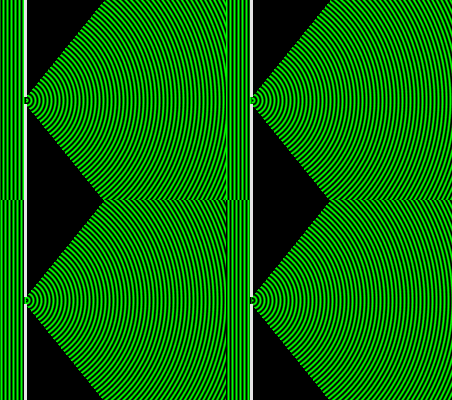
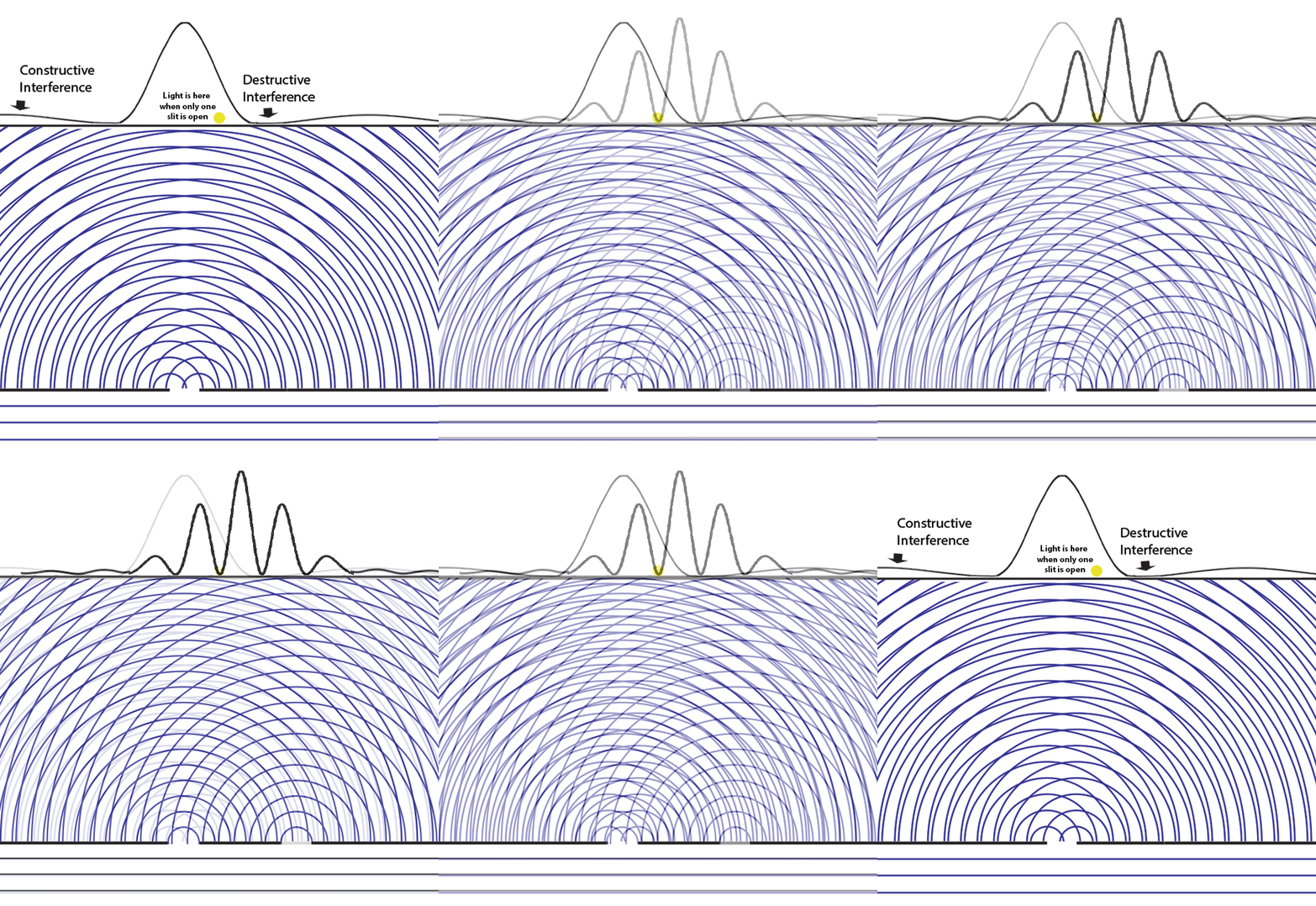
 Sarah zucker GIF - Find on GIFERThe Two-Slit Experiment and "One Mystery" of Quantum Mechanics

The difference is a characteristic effect if a wave occurs over a hole or an adhesion. And is closely related to the meaning of wave motion. In the 19th century, a contrast to ripples on the surface of light and liquids was well established. In 1927, while working at Bell Labs, Davison and Lester Germer performed an experiment. Nickel shows that the electrons on the surface of a crystal are different. This famous Davison-Germer experiment confirmed the De Brockley hypothesis. This is because the particles of matter have a wave-like nature. This is the central principle of quantum mechanics. In particular, observing their variation allowed the first measurement of the wavelength for electrons. The measured wavelength was well accepted by Lambda de Brockley's equation. lambda = h / P, where h is Planck's constant and p is the momentum of the electron.


While doing his graduate work at Princeton, Davison met his wife and life partner, Charlotte Sarah Richardson. He visited his brother Professor Richardson. Richardson was the brother-in-law of Oswald Webvan, a prominent mathematician. He shared the Nobel Prize with Giorgio Bake Thompson in 1937 for his discovery that electrons have an interference effect like light waves. Nobel laureate Clinton Joseph Davison passed away on February 1, 1958, in Virginia, the USA at the age of 76. Davison was named by the IAU in 1970 after an impact crater far from the moon.

Source By: Wikipedia.

Information: Dr. P. Ramesh, Assistant Professor of Physics, Nehru Memorial College, Puthanampatti, Trichy.


Wednesday, October 20, 2021

Today (October 21, 1833) is Alfred Nobel Birthday, the Swedish scientist who formed the Nobel Prize and invented the dynamite ammunition.

Today (October 21, 1833) is Alfred Nobel Birthday, the Swedish scientist who formed the Nobel Prize and invented the dynamite ammunition.


Alfred Bernhard Nobel was born on October 21, 1833, in Stockholm, the fourth son of an inventor and engineer Emmanuel Noble and Carolina Andries Noble. In total, they had eight children. Due to family poverty, only Alfred and his three brothers survived childhood. Through his father, Alfred Nobel is a descendant of the Swedish scientist Olaus Rudbeck. Alfred Nobel became interested in engineering at a young age, especially in explosives. His interest in technology was instilled in him by his father, a former student at the Royal Institute of Technology in Stockholm.


Following various business failures, Noble's father moved to St. Petersburg in 1837, where he grew up to be a successful machine and ammunition manufacturer. He invented modern plywood. And began work on the "torpedo" involved. Prosperous his parents, private teachers were able to send Nobel to classes. So he excelled in chemistry and languages. As a boy, he was fluent in English, French, German, and Russian. During 1841-1842, for 18 months, Noble attended the Jacobs Apologic School in Stockholm, the only school he attended during his lifetime. As a young man, Noble studied with the chemist Nikolai Jenin. Later, in 1850, he went to Paris for this work. At the age of 18, he collaborated for a short time under inventor John Erickson, who carried out chemical research in the United States for four years.


John Erickson designed the Ironclad USS monitor for the American Civil War. Nobel filed his first patent for a gas meter in 1857. The family's factory had been producing weapons for the Crimean War. But after the end of the Crimean War, they went bankrupt as it was difficult to switch back to domestic production. In 1859, Noble's father left his factory with his second son, Ludwig Noble. He made great business progress. Noble and his parents then returned to Sweden from Russia. Nobel devoted himself to the study of explosives. In particular, nitroglycerin (discovered in 1847 by Ascaniro, a student of Theophilus Jules Philos at the University of Turin, was of great interest in safe production and use.


On September 3, 1864, five people, including Noble's younger brother Emil, were killed in an explosion in a shed used to make nitroglycerin at a factory in Helenborg, Stockholm. Nobel, however, went on to build more factories to improve the stability of the explosives he developed, despite minor accidents. Noble invented dynamite in 1867, an easier and safer material to handle than unstable nitroglycerin. For dynamite, patented in the US and UK. It was also used for mining and international transport networks. In 1875 Noble discovered gelignite, more stable and more powerful than dynamite. Nobel was later elected a member of the Royal Swedish Academy of Sciences in 1884, the organization that selects people for two Nobel Prizes. He also received an honorary doctorate in 1893 from Uppsala University.


The Noble brothers Ludwig and Robert became very rich in their own right by using the oil wells on the Caspian coast. Nobel also invested in it and amassed great wealth through the development of new oil fields and issued 350 patents internationally. Although a Nobel laureate, he founded 90 arms factories before his death. In 1888, following the death of his brother Ludwig, several newspapers misrepresented Alfred's condolences. A French condolence message stated that the merchant of death had died (Le Marchand De La mort est Mort). In 1891, after the death of his mother and his brother Ludwig, Nobel moved from Paris to San Remo, Italy. He was shocked to see the news of his death in the French newspaper "Death Merchant Death". He became seriously concerned about how he would be remembered after his death. This is what made him change his will.

 dynamite | BOOK OF DAYS TALES

To everyone's surprise, Nobel's last will stated that most of his wealth should be used to give gifts in the fields of physics, chemistry, peace, medicine, and literature to those who have contributed to the "progress of mankind." Noble wrote many wills during his lifetime. His last will and testament were written and signed on November 27, 1895, at the Swedish-Norwegian Forum in Paris. He wrote 94% of his wealth, 31 million Swedish kronor (150 million euros, 186 US dollars as of 2008), for five Nobel Prizes. Approved by the Norwegian Parliament on April 26, 1897, due to doubts over his will. The "Nobel Foundation" was set up by those who were to enforce the Nobel Prize, to preserve his property and to regulate/regulate the awarding of gifts.


According to Nobel notes, the Norwegian Nobel Committee was set up to award the Nobel Peace Prize, and its members were elected within days of the will be approved. After that, groups were formed to present other gifts. They were proclaimed by King Oscar II in 1900 after the rules of how the prizes were to be awarded were approved by the Nobel Foundation in 1900. Norway and Sweden split in 1905. Since then, Norway has been responsible for awarding the Nobel Peace Prize, and Swedish organizations have been responsible for awarding other prizes.


The visionary Alfred Nobel, internationally recognized and acclaimed by many of the world's foremost scientists and literary figures, passed away on December 10, 1896, in Sanremo, Italy at the age of 63 due to a cerebral haemorrhage. Unbeknownst to his family, friends or fellow students, he left his fortune to present the Nobel Prizes. He was buried at Nora in Stockholm. The synthetic element Nobelium was named in his memory.

Source By: Wikipedia.

Information: Dr. P. Ramesh, Assistant Professor of Physics, Nehru Memorial College, Puthanampatti, Trichy.


Tuesday, October 19, 2021

Today (October 20, 1891) is the Birthday of Sir James Chadwick, the father of nuclear physics, who won the Nobel Prize in Physics for his discovery of the neutron.

Today (October 20, 1891) is the Birthday of Sir James Chadwick, the father of nuclear physics, who won the Nobel Prize in Physics for his discovery of the neutron.

Sir James Chadwick was born on October 20, 1891, in Bollington, Cheshire, to John Joseph Chadwick and Ann Mary Knowles Chadwick. He attended Bollington Cross Church of England Primary School and the Grammar School for Boys in Manchester. He also studied at Victoria University and Cambridge University in Manchester. In 1913, he was admitted to the Berlin University of Technology. There he was educated under Hans Geiger and Ernest Rutherford. Chadwick was in Germany at the beginning of World War I. There he was detained at the Rulben detention camp. He was also allowed to set up a laboratory. There he, with the assistance of Charles D. Ellis, studied the ionization of phosphorus and the photochemical effects of carbon dioxide and chlorine. 

He spent most of his life in Rulepen until Geiger's laboratory tried for his release. In 1932, Chadwick discovered a previously unknown fabric in the nucleus. Published detailed explanations of his findings. The dress was first anticipated by Ettore Majorana. It is called a neutron because of its electrical neutrality. Chadwick's discovery was instrumental in understanding the fission of uranium-235. Because the albatross fabrics are positive, they are pushed by the nucleus accumbens. But since neutrons are unstable, they do not need to cross the coelomic barrier. Thus they were able to penetrate heavier atoms such as uranium-235 and plutonium nuclei. 

In 1932, Chadwick was awarded the Royal Society's Hawks Medal 1932 for his discovery of the neutron, and in 1935 the Nobel Prize in Physics. Chadwick's discovery made it possible to produce heavy elements in laboratories, including uranium. This is possible by colliding neutrons formed by beta decay. His discovery impressed the Italian physicist and Nobel laureate, Enrico Fermi. Thus he began to study the chemical effects of neutrons colliding with atoms. The first type of nuclear fission was discovered by studies published by Fermi and by German radiologists Otto Hahn and Fritz Strassmann.

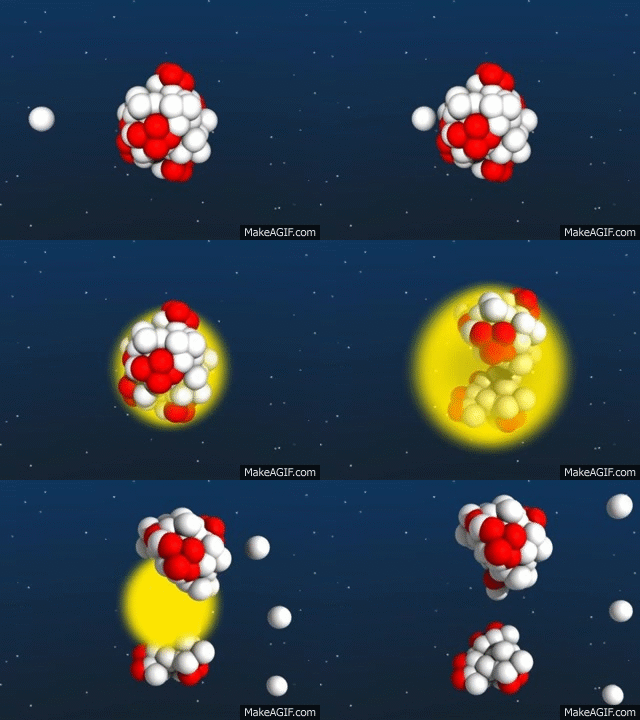
 Nuclear GIF on GIFER - by Graris

In 1935, Chadwick became a professor of physics at the University of Liverpool. In 1940, he was appointed to the MAUD Committee due to a memorandum by Fritz Piels directing the manufacture of the atomic bomb. The AQ team further explored the material. He visited North America in 1940 as part of the Desert operation. There he was involved in integrating nuclear research between Americans and Canadians. When he returned to England in November 1940, he thought that nothing would come out of this study until after the war. In December 1940, MAUD executive Franz Simon announced that uranium-235 could be extracted. Simon's report also covered the costs and technical requirements for a massive uranium enrichment plant. "Atomic bomb is not only impossible, but it is also very essential.

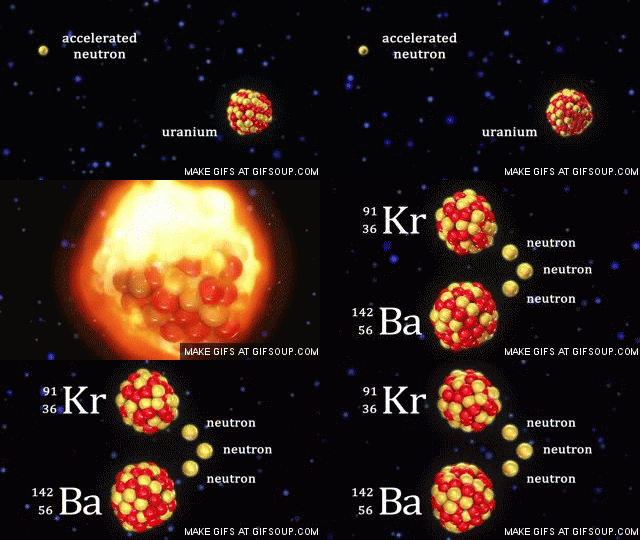
 Nuclear Fission Animation for Science on Make a GIF

Shortly afterwards, he joined the Mankato Project in the United States. The two atomic bombs created by the project were dropped on the Japanese Empire. Thus ended World War II in mid-August 1945. In 1940, Schwick sent technical reports to the Royal Society of two French scientists, Hans von Halfen and Liu Kowarski, who were studying in Cambridge. He called for the reports to be kept secret, as it was not appropriate to publish them during the war. In 2007, staff at the Royal Society discovered the reports during an audit. 

Explosion Boom GIF - Explosion Boom - Discover & Share GIFs | Atomic bomb  explosion, Nuclear bomb, Atomic bomb

He was also a leading British scientist who participated in the Manhattan Project in the United States during World War II. He was knighted in 1945 for his directory in physics. Sir James Chadwick, the winner of the Nobel Prize for his discovery of the neutron, passed away on July 24, 1974, in Cambridge, England at the age of 82.

Source By: Wikipedia

Information: Dr.  P. Ramesh, Assistant Professor of Physics, Nehru Memorial College, Puthanampatti, Trichy.

Monday, October 18, 2021

Today (October 19, 1910) is the Birthday of Nobel Prize-winning Indian physicist Subramanian Chandrasekhar, who discovered that a small star could explode and form a bright 'supernova'.

Today (October 19, 1910) is the Birthday of Nobel Prize-winning Indian physicist Subramanian Chandrasekhar, who discovered that a small star could explode and form a bright 'supernova'. 

Subrahmanyan Chandrasekhar was born on October 19, 1910 in Lahore, Punjab, India (now Pakistan) to C. Subramanian Iyer and Sita Lakshmi Amma. His father worked as a government official. Subramanian Chandrasekhar's family moved to Chennai after spending five years in Lahore and two years in Lucknow. He attended the Hindu High School at Tiruvallikeni in Chennai and later pursued his higher education at the State College and obtained his BA in Physics from the same college. It was during this time in 1928 that his uncle Sir C.V. Rama received the Nobel Prize. 

In 1928, when Arnold Sommerfeld came to India, he lectured at the State College in Chennai. Chandrasekhar, who had already read his book, met him and learned about the new research that had taken place in physics and paid close attention to reading books about them. As a result, he published his first research paper the following year. A lecture similar to this article was given at the Indian Science Conference in Chennai that year with the admiration of senior scientists, and his research journey began successfully. Also, the following year at the age of 19, while still an undergraduate, two more articles were published. In 1930, with the gift and financial assistance of the Government of India, Chandrasekhar traveled to Cambridge University for further studies. 

Professor R. H. He continued his research work as a research student under Fowler, earning a doctorate in 1933 from the University of Cambridge. He later became a research professor at Trinity College, where he met Arthur Eddington, a world-renowned astronomer. He was excited to have the opportunity to interact with his favorite researcher. Later, he returned to the UK and continued his research work, publishing numerous research papers on the structure of galaxies, as well as specializing in various areas of his research. Then, in 1937, he was sought by astronomers at the University of Chicago in the United States. He happily traveled to the United States to continue his work, educating students and continuing his research.

                                 subrahmanyan chandrasekhar | Tumblr

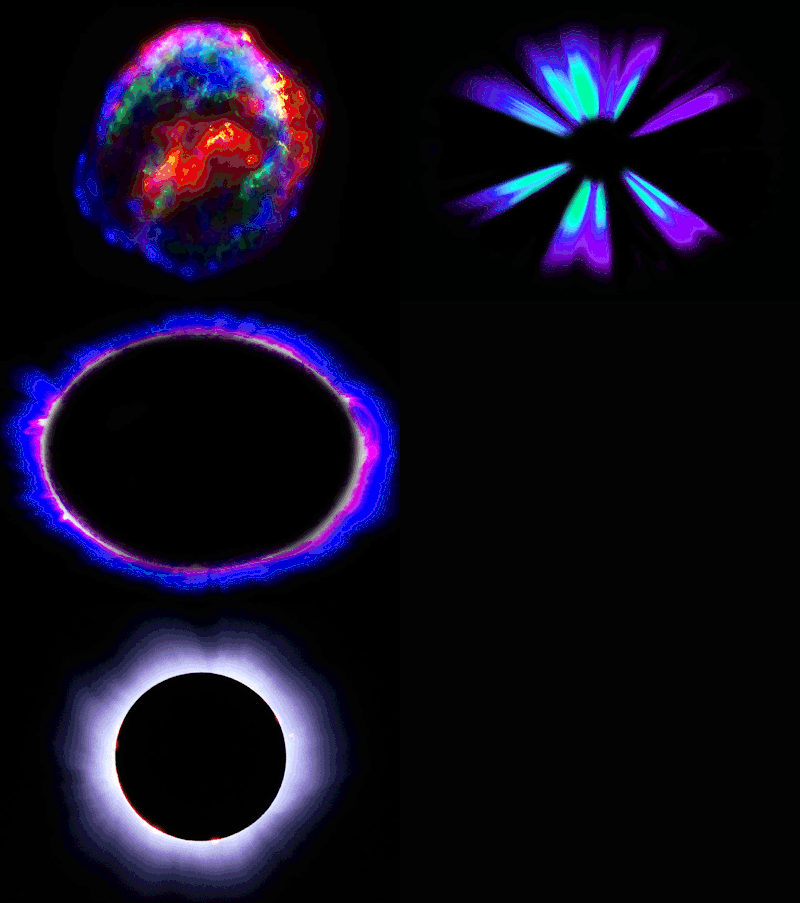
Chandrasekhar was very interested in physics and space science. He excelled in it. He made a definition of the weight of stars in astronomy. The star, which is 1.4 times the mass of the Sun, was found to lose its stability. It is called the Chandrasekhar Limits. He discovered that as the white small star weighed more, its nucleus would explode like a 'nuclear bomb' and form bright 'supernova' stars. He discovered how stars in the Milky Way share the movement of objects. Through this it was possible to understand the ecosystem of the stars. And discovered why the sky is blue.

                     Chandra finds evidence for serial black hole eruptions in NGC 5813 –  Astronomy Now

In addition to being a well-respected professor at the University of Chicago, he published a book entitled "The Structure of the Stars" which summarizes his research so far. He has also published numerous articles on astronomy, earning him awards and medals from various countries. In 1983, he and William Fowler were awarded the Nobel Prize in Physics for their research on galaxies, taking him to the pinnacle of fame.


While working as an astronomer at the University of Chicago in the United States, he married Lalita, who had studied with him at Presidency College when he came to India. While studying, he was a suitable companion in marriage because they were well acquainted and was the impetus for his research. Subramanian Chandrasekhar, the Nobel Prize-winning Indian physicist, passed away on August 21, 1995 at the age of 84 in Chicago, USA.

Source By: Wikipedia

Information: Dr. P. Ramesh, Assistant Professor of Physics, Nehru Memorial College, Puthanampatti, Trichy.


தென் துருவ பனியில் பிரபஞ்ச ரகசியங்களை கண்ட விஞ்ஞானிக்கு நோபல் பரிசு.

தென் துருவ பனியில் பிரபஞ்ச ரகசியங்களை கண்ட விஞ்ஞானிக்கு நோபல் பரிசு. உயர் ஆற்றல் நியூட்ரினோக்களை கண்டறிந்த பிரான்சிஸ் ஹால்சனுக்கு 2026 இயற்ப...